If you don’t see your question answered among these, please email us at:
FAQ@looneylabs.com
- Q: In Martian Chess, one is not allowed to undo an opponent’s move, but what if their move made a capture?
- Q: In Martian Chess, what happens if players keep moving a potential last piece back and forth over the border so that the end condition cannot be reached?
- Q: When you do a Field Promotion in Martian Chess, where does the new piece come from?
- Q: In Martian Chess, is it permissible to create a new Queen on the board via Field Promotion in excess of the number the game started with?
Q: In Martian Chess, one is not allowed to undo an opponent’s move, but what if their move made a capture?
…Moving their piece back to the same spot wouldn’t undo the capture, so is that allowed?
A: To review: the NO UNDOS rule states that one may not “reject” another player’s move. If one player moves a piece across the canal, the other can’t move it back to the same square it came from.
While the rule is called “no undos,” that’s just a shorthand title. It’s the move itself, not the capture, which you are not allowed to reject by sending the piece back to its immediately previous location.
Q: In Martian Chess, what happens if players keep moving a potential last piece back and forth over the border so that the end condition cannot be reached?
A: Ending a Deadlock: During the final stages of the game, the action slows down and may become stagnated. If any player feels the game has reached a state of deadlock, during their turn they may “call the clock.” From that point on, if seven moves go by in which neither player captures a piece, the game ends and the final score is computed. If someone makes a capture, the counter is reset.
Resolving a Tie: If the final score is tied, and one Zone is empty, the player who ended the game is the winner. But if the game ends in a deadlock with a tie, the result is simply a tie. Play again!
This has been added to the rules in the stand-alone small box set, but previous iterations of the rules did not include this info.
Q: When you do a Field Promotion in Martian Chess, where does the new piece come from?
A: For both types of promotion, the pip count of the new piece is the same as the pip count of the old pieces. Since scoring is by pip count, you can take the new piece from either player and give them the old pieces. Their score remains the same.
(Thanks to Jeff Wolfe for fielding this question a bunch of times, and writing it up for the FAQ.)
Q: In Martian Chess, is it permissible to create a new Queen on the board via Field Promotion in excess of the number the game started with?
A: It’s extremely unlikely that the situation would occur that zero Queens have been eliminated in the game by the time you are eligible to create one via Field Promotion, but if it happens, yes, it is allowable. If you meet the criteria of having no Queens in your own territory, you may create one via Field Promotion, even if this means there are more Queens in the game than it started with.
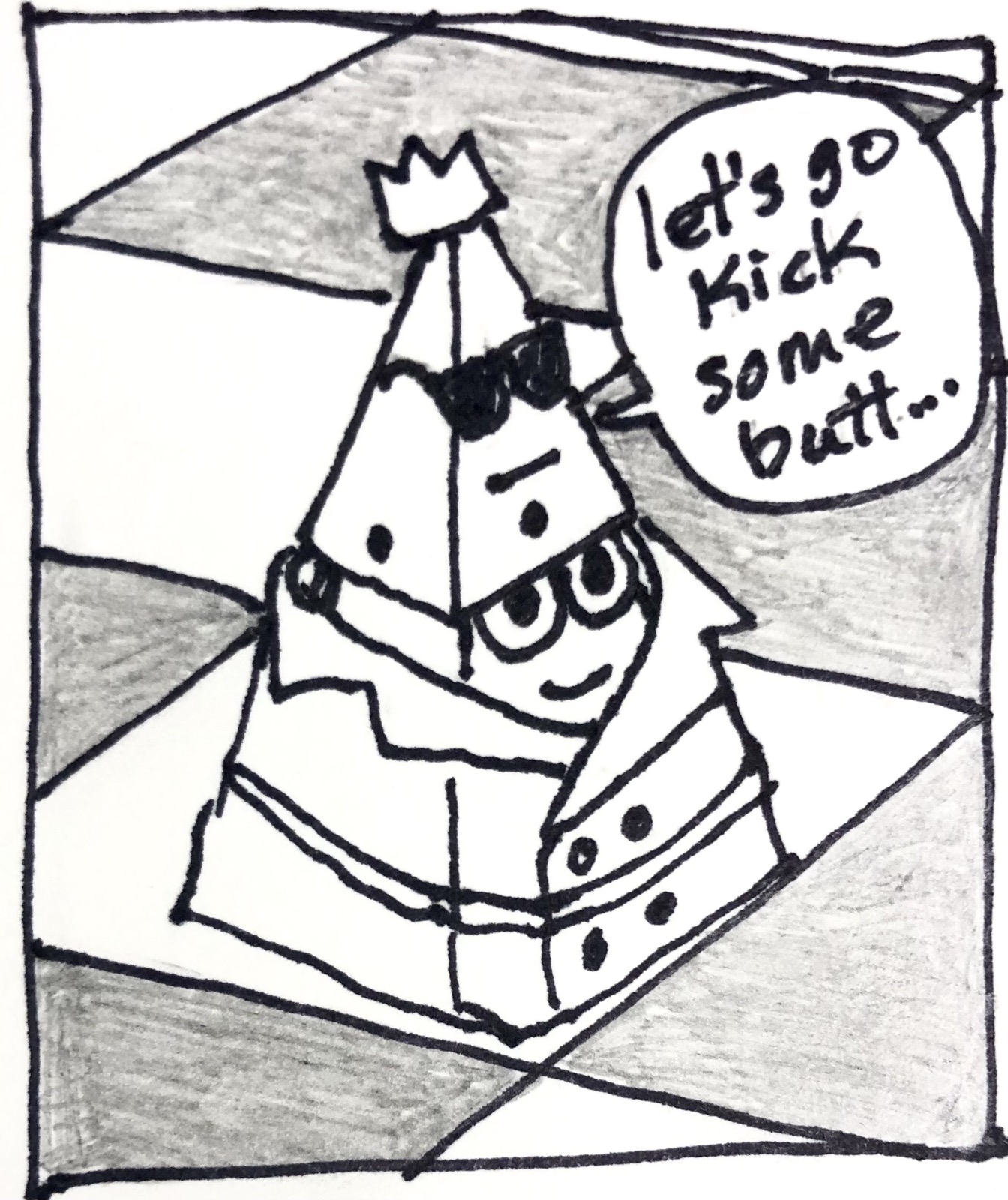
If you don’t have any additional Queens in your collection to substitute in for the Pawn-Drone combo on the board, just move the two stacked pieces as though they were a Queen.
(It’s kind of like your Pawn climbs onto the shoulders of your Drone, and they put on a single trenchcoat, and they’re functionally indistinguishable from any other Queen on the board – which implies by extension that three Pawns in a trenchcoat could also be a Queen…)