…such that you’d discard the one in play when you play one of the others (for example, if you were mixing decks, or had one as a promo card in a deck with another one)?
A: The original card of this type, which we’ll call Numeral-Altering Rules, is Inflation, which is found only in the “base” versions, but there are several other New Rules which alter quantities, available in other versions or as promo cards. They all have certain key parameters in common:
• They only affect other cards (they do not affect themselves)
• They only affect numbers expressed as numerals, i.e. (1), not those written out by name, i.e. (one).
It is understood that New Rules will accumulate on the table as they are played, unless a New Rule contradicts one already in play, in which case the previous one is discarded, and the newer one takes its place. Most Rules which replace each other are in clear categories, and we note them on the card. For example, Draw Rules replace previous Draw Rules; Play Rules replace previous Play Rules, etc.
But for this type of rule, because of they way they refer to quantities on other cards, it’s clear that the game would break in almost* all cases if there were more than one on the table, in the same way that it would break if they applied to themselves.
For reference and comparison, here are the Numeral-Altering Rules:
• Inflation (Fluxx 3.x-5.x, loose promo card) Increases all numerals by 1.
• Mathematical (Adventure Time) Same as Inflation, but with an alternate name.
• Increment All (Math) Same as Inflation, but only affects Actions and New Rules (so it won’t change the Keepers, which are all numerals, or the Goals that refer to them).
• Double Vision (Remixx, Drinking, & promo in the More Rules pack) Changes 1 to 2.
• One, Two, Five! (Monty Python) Changes 3 to 5.
Now, if you’re paying attention, you will have noticed that none of the first three can functionally coexist with any of the others, but the last two actually don’t affect each other. 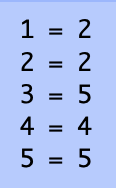 *You could, technically, have both Double Vision and One, Two, Five in play at the same time, and numerals would have the following equivalencies, shown in the table to the right.
That said, we would recommend that you choose to treat these as mutually exclusive as well, for simplicity’s sake. Then again, if you’re mixing up cards like this, you’re probably not all that invested in simplicity…